Showing posts with label Bank Loans. Show all posts

Friday, 8 August 2014

PART 4 - TYPE OF LOAN DEFAULTS

As I said before, even in “normal” and “healthy” economic climate there are bound to be loan defaults as it is “by design”. “New money” chasing “old money” or ”other new money” to pay for the loan as the interest has “stolen” from the money supply.

Those who are financially “weaker” will be the ones generally who will default first and others will eventually follow suit. "The design" of USURY or RIBA based system will ensure that new debts will have to be created to pay for the old debt where there will never be enough "money" to go around. For revision of the usurious system, you can visit this link:

Facts About Digital Money

When there is an economic crisis, the loan default rates will multiply many times over. This is where the collection department of Banks and Collection Agencies would have to intensify their collection efforts for their own survival like what happened in the Asian Financial Crisis in 1997. During that time, collection was low, repossession of vehicles reached record highs, foreclosures of property were aplenty and Bankruptcy proceedings were rampant.
The returns from principal and interest were not enough to cover for operational expenses (lower returns of interest portion as loans get "older") and new loans were frozen, so "new money" could not be created with "higher" portion of interest/USURY for the "rolling of expenses". Finally the aid from the government in the form of "bailout" was needed to prevent the Banks from going under and restore the confidence of the people in the monetary system.

Maybe we will have a special session dedicated to the Asian Financial Crisis of 1997 to reminisce and learn from it in order to at least be "better prepared" for the incoming and expected bigger crisis. Many of you readers may still be too young to remember or even still wearing diapers when the said crisis of 1997 happened so it is good to know.

Ok, back to the types of loan defaults. The type of loan defaults can be divided into the following categories (these are my classification and might be slightly different from the classification from Banks and Central Banks)

1)      Potential Non Performing Loan – Loans that are overdue from 1 to 3 months. These are sometimes considered “normal” and “active” accounts but need to be monitored closely. Phone calls and simple reminder letters are normally used.

2)      Non Performing Loan or Doubtful Debts – Loans that have the potential to die off and become bad debts. Usually overdue from 4 to 12 months. More frequent follow ups sre required and normally already under litigation.

3)       Bad Debts – Loans which remain unpaid for more than 12 months.  Either in advanced stage of litigation and depending on the respective policy of Banks, these accounts may be written off and transferred to a department specializing in “cold” accounts. On the other hand, there are some accounts where legal actions are still undergoing would not be written off just yet, just isolated from the “active” accounts. The “income” from the interest from these accounts will be suspended in line with the guidelines from the Central Bank normally from the seventh month of default until the account becomes active again. For “write off” accounts, whatever amount paid is considered as profit after considering all recovery costs since it has been recorded as a “loss”.


The loan recovery process in the above three categories depends on the respective internal policies of the Banks. For the 1 to 3 months category, it is normally handled by the Banks staff because it is relatively “easy”, that is by “cordial” phone calls, sms (text messages) and reminder letters which nowadays generated by computers.

For car loans, it is governed by “The Hire Purchase Act 1967 (latest amendment 2012) where the Banks will have to follow the provisions of the said act in terms of recovery of the vehicle. Legal action may be taken after efforts to recover the car as provided by the act failed.
As for personal loans and credit card loans “affectionately” known as “unsecured loan” (may be “secured” by a guarantor) the usual process of recovery such as phone calls, reminders, lawyer’s letter of demand, court summons and judgment are used.

With regards to property loans, the usual recovery process as unsecured loans will be carried out.  However, when it comes to foreclosing the property, the Banks would have to abide by the provisions of the National Land Code. Wow! That sounds complicated you might say. Don’t worry, I will try to give a detailed info graphics on each recovery process for each loan category in part 6 of this topic.
It is hoped that by knowing the procedures especially the TIME FRAME for each legal action, you will not be bullied with impunity by the Bank or the Debt Collection Agency staff with threats such as "TOMORROW we will make you a Bankrupt" or "TOMORROW we will auction your house" or "TOMORROW we will deduct your salary" and a few other "TOMORROWs"

Nevertheless, we also need to understand that the "collection guys" need to resort to such tactics to pile the pressure on the borrowers to get the debt paid . They are paid to do that and for the Debt Collection Agency staffs, they are actually "collecting" their salary but some have overstepped their boundaries in terms of proper collection guidelines and ethics.

However, please be reminded that if the proper legal procedures has been followed, the above threats are REAL, the bluff is in the timing and time frame or whether it has been executed at all. This is where the borrowers need to be aware of their rights and at the same time be responsible for the agreement that they have signed with the Banks in the first place.

As long as they have the legal right to collect the debt (unless prohibited by the Limitation Act due to "expiration" of the right to claim), they (the Banks and Collection Agents) are entitled to do so. I am not teaching you to run away from your debt but to give you the understanding of the collection procedures and the proper collection ethics and the channels in which you might get help. So keep on reading..

END OF PART 4
NEXT: PART 5 - THE COLLECTION DEPARTMENT


PART 3 - TYPE OF LOANS IN THE HOUSEHOLD DEBT PORTFOLIO

The household loans are typically divided into the following categories:
1)      Housing Loan
2)      Motor Vehicle Loan
3)      Credit Card Loan
4)      Personal Loan
5)      Furniture and Household Items Loan
Housing loans and car loans are the major contributors to the household debt which is understandable given the relatively young population. The lure of “attractive” (low) interest rates managed to soften the impact of the high price of houses and cars which has escalated over the years. The mix of high interest rates and high prices of these two necessities would cripple demand and is not good for the economy. Malaysians has been "enjoying" low interest rates for several years already which has largely contributed to the huge debt bubble.
Credit card debts can be seen as a “side loan” or “supplementary loan” (in the beginning) to cater for petrol expenses and groceries and even dinner at “selected” restaurants when money (from wages) runs out especially after the inflation rate has gone up since January 2014. Of course there those who use credit card to satisfy their “compulsive shopping” habits while digging their financial freedom away. Personal loans are normally used for investment purposes in order to ease their financial burden or simply to cover for their already mounting debts scattered like birds’ droppings.
Personal loans are also used for glamorous engagement and wedding ceremonies successfully propagated by local celebrities which is the trend nowadays in order to “keep up with the Joneses”. This is a recipe for disaster especially if the newlyweds previously had student loans before (called PTPTN here).
After marriage, loans for furniture and fittings as well as electrical goods are easily available through companies like Courts Mammoth, Aeon Credit and Seng Heng with incredible offers like “you will only pay three months later” or “celebrate your Eid or whatever first and pay later” and of course with credit card type interest rates. Another recipe for financial calamity.


So there you are. The various types of debt in the household debt stockpile. Sorry for the long introduction because it has to be done to have a clear understanding of the types of debt involved and you will see the reason behind this as we go along in line with the topic “Debt Collection Agencies – The Collection of Current and Bad Debts”. So bear with me.
With all the monthly loan commitments, some are doing okay with their current income, some are  merely surviving which is not bad but many have to resort to juggle their expenses or juggling their time to earn extra income through side business or part time jobs. Some are committing financial suicide by juggling their credit cards or alternating their monthly payment (pay housing loan, miss the car loan or other loan and change the order of payment next month) so that they are always “on the edge” with regards to legal action.
If everything is stable which means if all prices of goods and services are “static” with no major changes, then well and good. But we are living in a debt based economy where inflation is a necessity. Dependency on the US Dollar as “THE” reserve currency goes to show how precarious is our position now as an economic calamity can happen at any time.
Domestically, the government burdened with debt would have no choice but to reduce subsidies for petrol and other essential items resulting in escalating prices for most food items, services and utilities across the board. This is where the pressure to keep on paying the monthly payments becomes unbearable and eventually loan defaults becomes inevitable. Those in the “I’m okay” and “I have no problem so far” are also affected. Those “I couldn’t afford it, but I want it anyway” group are already in the financial pit of no return.


END OF PART 3
NEXT: PART 4 - TYPE OF LOAN DEFAULTS

PART 2 – QUALITY OF BORROWERS

Another factor that we need to understand is that Banks give loan to a diverse group of people in terms of their “financial strength”, “credit worthiness” or simply the ability to service the loan. Of course Banks are always prudent in giving out loans and screening their borrowers but in some cases, “borderline” and “a bit above borderline” borrowers do exist where loans are given with the assumption that their economic well being might improve over the years with yearly increment of their salary. Factors like recession cycles and global financial instability are not really taken into greater context as the economy is always expected to “grow” indefinitely with inflation being the unavoidable side effect. On the other hand, you may also get loan based on the “know who”  technology inside the Bank even though your credit standing is not so good. The “bigger” the person in the hierarchy that you know, the “bigger” and the higher risk loan and lower interest rate you may get and this sometimes happens in the banking circles.


Therefore, in “normal” circumstances where everybody is “chasing” money to pay for their loans, there are bound to be people who will fall on the wayside and normally most of them are the “borderline” cases while there may also be those from the “prime” category due to business failure or some other factors.
Things will go haywire when there is an economic crisis like what happened during the Asian Financial Crisis due to currency manipulation in 1997 where "good" and "consistent" paymasters suddenly become "bad" borrowers. This situation may happen again with a greater impact given the current state of the global economy and the potential of a global scale war breaking out The after effects of the financial crisis of 2008 is still upon us where we were exposed to major frauds in the financial sectors particularly in the US and Europe. It is said that the US Dollar has lost 98% of its value and even if that is a correct estimate (probably it is a negative figure already), will only be worth RM0.06 sen and this is the value where oil is sold and this is the RESERVE currency of the majority of countries in the world. Now that is really living on the edge! "Owing" money created out of nothing and paying interest on it and having reserves which is basically worthless! Whatever the case may be, default will always occur due to the added value of interest or USURY and much more so in the current state of the economy where inflation has reared its ugly head and more and more people are finding hard to make ends meet and some are plunging deeper into debt just to survive and end up paying more interest in the form of  late charges for missing their scheduled payments. If we are to take the above RM755,000,000,000 figure, a default ratio (now with a more subtle name of “impaired” loan) of even 5% will give a figure of about RM38 billion. Ok, maybe some people will say that is too “high” so we will take the “accepted” industry standard of 2% as being “normal” and the figure should be around RM15,000,000,000 (billion)  which is also a lot of “money” (mostly in computers) and that is not including normal and compounded interest and late charges (also in the computer, not "released" yet)

END OF PART 2
NEXT: PART 3 - TYPE OF LOANS IN THE HOUSEHOLD DEBT PORTFOLIO

PART 1: BANKS AND DEBT COLLECTION AGENCY – CURRENT AND BAD DEBT COLLECTION

THIS IS NOT AN ADVERTISEMENT ON GET RICH QUICK SCHEME. THIS IS INFORMATION AND TIPS ON HOW TO HANDLE COLLECTION AGENTS.
Are you currently behind in your loan payment and currently sitting on a pile of debt? Being harassed by Banks lately or by people hired by the Banks called Debt Collection agencies where some of them are masquerading as lawyers? Feeling hopeless, scared and embarrassed by the threats of losing your job, your car or your house? 

Please choose your answer below:
A: Yes, definitely
B: Not yet, but coming soon
C: Maybe, but I think I’m okay (for now)
D: No, I am super rich, I don’t have a problem
E: No, I or my father or my grandfather owns the Banks and too big to go to jail. Muah! Ha! Ha! Ha!
F: I work for the Bank or Collection Agency. Why are you doing this? You are destroying our “weapons”
G: If this is a get rich quick scheme, I’m sorry, I’m not interested.

If your answer is D and E, you can skip reading this article. If your answer is G, no this is not a get rich quick scheme. If your answer is F, don’t worry, I understand your problem. There are some borrowers who simply do not want to pay unless sufficiently “pressured” and there are some who are simply a pain in the ass. I may highlight the predicaments of the collection guys in another article.
I just want to give a level playing field in this area since there are guidelines and procedures to follow and sometimes it has been abused by the Banks' personnel and Collection Agencies' staffs taking advantage of some gullible borrowers even if they “deserved” it. Enough of that and if I need to repeat myself, it is just giving some basic understanding and a level playing field and by the way, I am no angel either.
If your answer is A, B or C, don’t fret, help is on the way. No, I am going to help you pay your debts, but I would like to share some information that may alleviate your fears and may help you handle the situation in a more subdued or calm manner.

MALAYSIA'S HOUSEHOLD DEBT REACHING ALARMING LEVELS
According to the Central Bank of Malaysia’s recent report, Malaysia’s household debt has reached 86% of GDP, the highest in Asia (congratulations, we are number 1!) which works out to roughly around RM755++ billion (RM755,000,000,000). This figure changes everyday but we have reach a very worrying figure. GDP by the way is subjective and is also financed by debt but we shall discuss that in another post.
Let’s concentrate on the household debt and by looking at the figure, it is alarming indeed and it may well be close to or already reached RM1 trillion (RM1,000,000,000,000) if we take the “illegal” loans given by loan sharks into consideration.


WHEN THERE'S DEBT, THERE WILL BE DEFAULT
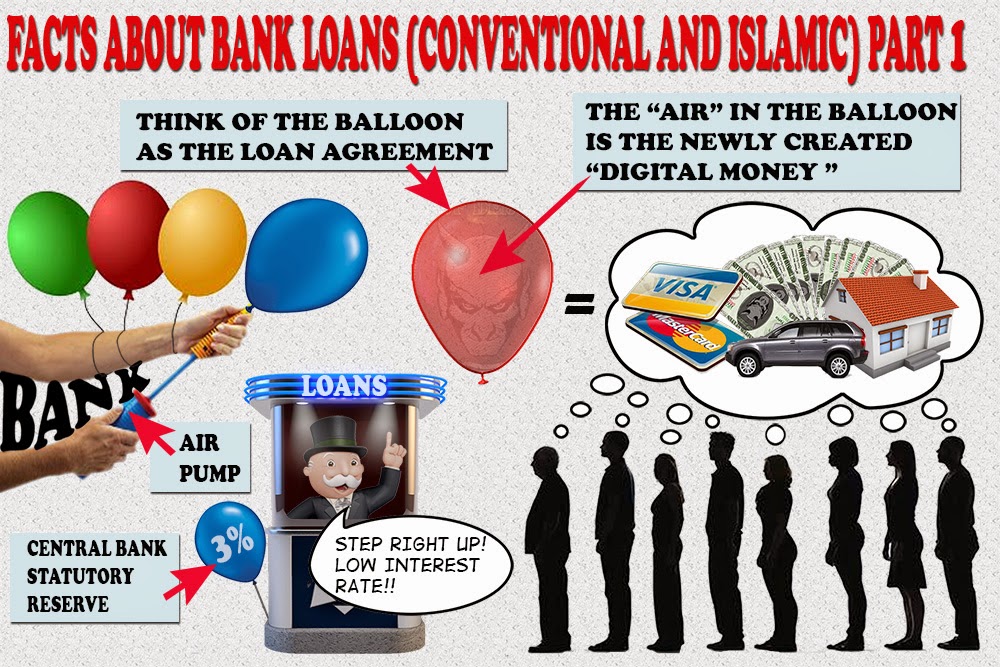
In order to understand “default” in loans, we need to understand the loan creation process. When loans are given, money are created out of thin air digitally as book keeping entries in the Bank’s computer. Interest charged are not created as money but is designed to eat up or steal the numbers from the newly created loan so that in order to service the loan in full, the borrowers would have to take from the existing money supply which incidentally are created in the same manner (with interest) so there will not be enough money unless “new” digital money are created through loans. Confused? Perhaps the diagrams below can give you some understanding.


For more details, you can view the slideshare presentation of the "Facts of Paper and Digital Money" here:
Facts about Paper Money

 END OF PART 1.